Permanent vs Temporary Staffing in Singapore: Which Works for Your Business?
For SMEs in Singapore, hiring the right people is often a balancing act between long-term stability and short-term flexibility. While permanent staffing provides continuity and loyalty, temporary staffing offers cost-effectiveness and agility during seasonal peaks.
Definition: Permanent staff are full-time employees hired directly by the company. They are integrated into the business, receive employment benefits, and are expected to stay long-term.
Key Features:
Full-time employees with contracts under MOM guidelines.
Eligible for CPF contributions, leave entitlements, and insurance.
Stronger integration into company culture and operations.
Best for:
Core business functions (e.g., operations, management, customer service).
Roles requiring deep product knowledge and continuity.
SMEs looking to build a loyal, long-term workforce.
💡 Pro Tip: Permanent staff bring stability, but the upfront cost of hiring, training, and retaining them is higher compared to temporary staff. Many SMEs offset this by grooming interns into future hires— Read Internship vs Part-Time Job for the candidate’s perspective on gaining early work experience
2. What is Temporary Staffing?
Definition: Temporary staff (also called contract staff) are hired for a specific duration or project. They may be recruited through a staffing agency or directly by the employer.
Key Features:
Short-term, project-based, or seasonal contracts.
No long-term benefits like CPF or medical coverage (if under agency contracts).
Quick onboarding but limited cultural integration.
Best for:
Seasonal demand (e.g., F&B during festive periods, retail during sales seasons).
Project-based work with defined timelines.
SMEs looking to reduce costs and increase flexibility.
💡 Pro Tip: Temporary staffing helps SMEs stay agile, but it often comes with higher turnover and weaker employee loyalty. For a deeper dive, read our Temporary Staffing in Singapore guide.
3. Permanent vs Temporary Staffing: Pros and Cons
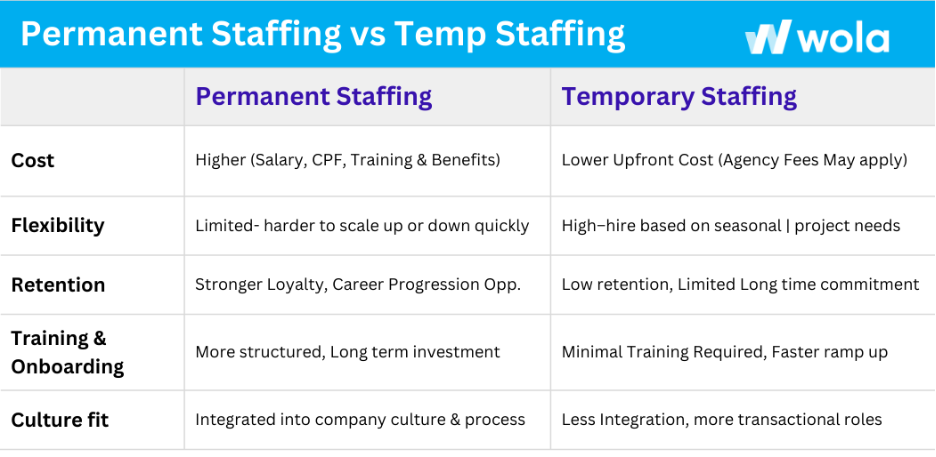
The key differences between permanent and temporary staffing typically lie in areas such as cost, workforce flexibility, employee retention, cultural fit, and the level of training and onboarding required.
The thing is, hiring permanent staff when you only need temporary support could inflate your costs. Conversely, relying solely on temporary staff can hurt continuity. Hence, many SMEs benefit from a hybrid approach—learn more in Permanent vs Temporary Staffing: Which Works for Your Business?
Some SMEs also explore Employer of Record (EOR) services as an alternative, gaining flexibility while staying compliant with Singapore’s hiring regulations.
4. Which Staffing Model Works Best for SMEs in Singapore?
The answer depends on your business needs, industry, and growth stage:
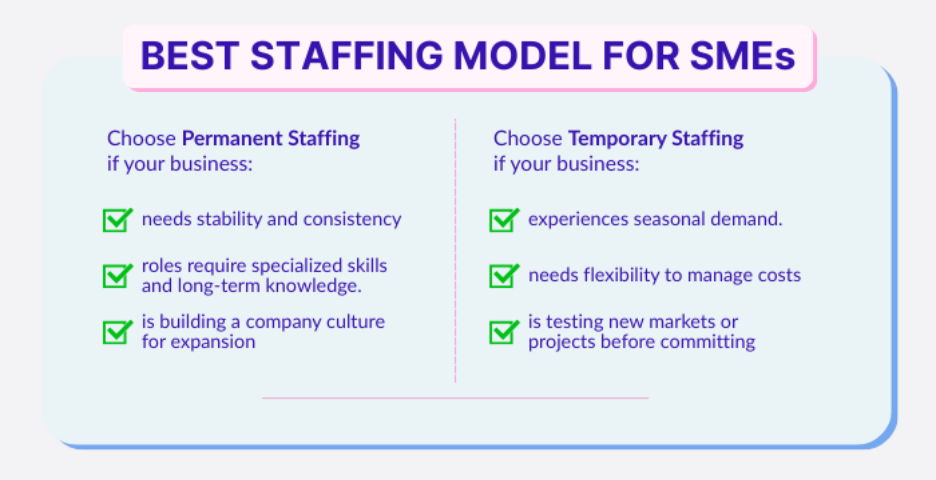
Choose Permanent Staffing if:
You need stability and consistency.
Your roles require specialized skills and long-term knowledge.
You’re building a company culture for expansion.
Choose Temporary Staffing if:
Your business experiences seasonal demand.
You need flexibility to manage costs.
You’re testing new markets or projects before committing.
👉 Many SMEs benefit from a hybrid staffing model—combining permanent staff for critical roles and temporary staff for peak periods. Seasonal industries like F&B staffing and Retail staffing often rely heavily on this balance. Check our F&B Hiring Challenges and Retail Hiring Made Easy articles for sector-specific insights.
5. Building a Sustainable Workforce Strategy
Instead of choosing only one staffing model, SMEs can blend both approaches while investing in a talent pipeline:
Partner with a staffing agency for temporary manpower when demand spikes.
Invest in training and upskilling to retain permanent employees—resources like SkillsFuture can help.
Offer non-monetary benefits (flexible work, growth opportunities) to attract both permanent and contract staff.
See our guide on Internships for Employers for practical tips on building future leaders.
6. Compliance Considerations
Whether hiring permanent or temporary staff, SMEs must comply with Singapore’s employment laws:
MOM regulations: Employment Practices.
CPF contributions and quotas.
Foreign manpower hiring rules under the Fair Consideration Framework.
Failing to comply can result in fines or operational risks—many SMEs reduce this risk by working with a staffing agency or exploring EOR solutions.
Conclusion
There’s no one-size-fits-all answer to permanent vs temporary staffing in Singapore. For SMEs, the key lies in balancing stability with flexibility:
✅ Use permanent staff to build core functions and long-term growth. ✅ Use temporary staff to scale during seasonal or project peaks. ✅ Consider a hybrid model with internships to secure future talent.
Kickstart your blue-collar career in Singapore with the right job search strategies, internships, and upskilling opportunities. Learn how locals, PRs, and foreigners can grow in retail, F&B, logistics, security, and manufacturing.
Hiring permanent staff in Singapore can be challenging for SMEs. Learn common pitfalls, costs, and strategies to build a sustainable workforce, including talent pipelines and internship programs.
Working a temporary job in Singapore? Learn simple steps to increase your chances of getting a permanent role — from showing reliability to upgrading your skills.
Kickstart your blue-collar career in Singapore with the right job search strategies, internships, and upskilling opportunities. Learn how locals, PRs, and foreigners can grow in retail, F&B, logistics, security, and manufacturing.
Unsure whether to take an internship or part-time job in Singapore? Learn the key differences, benefits, and career growth opportunities for locals, PRs, and foreigners in F&B, retail, hospitality, logistics, manufacturing, business, and security.
Working a temporary job in Singapore? Learn simple steps to increase your chances of getting a permanent role — from showing reliability to upgrading your skills.
Hiring permanent staff in Singapore can be challenging for SMEs. Learn common pitfalls, costs, and strategies to build a sustainable workforce, including talent pipelines and internship programs.
Start your very own organisational internship program today
Save precious human resource hours from arduous employee candidate search process, vetting, onboarding and more. Get a dedicated pipeline of affordable and trained manpower today.